

The holiday season is approaching, and once again, we all look forward to switching off and giving our bodies the rest they need. Once you arrive at your dream holiday destination, you suddenly notice that something is brewing, and your body is trying to fight something off: gastrointestinal upsets, colds, and fever. People often get sick during their long-awaited holiday – but why is that? We'd like to explain exactly that in this post. Furthermore, we'll give you valuable tips on how to support your immune system and your gut before and during your trip.
Table of Contents
Why travel particularly affects the immune system
Who hasn't experienced it: The holiday has been booked for a long time, and the anticipation is huge. But as soon as the long-awaited holiday is at hand, you suddenly fall ill. Worse still: You catch something nasty during your holiday, can't tolerate the food, or just can't get going due to exhaustion. This is unfortunately far removed from cosy evenings, beautiful walks on the beach, swimming in the sea, and delicious meals out. But why does our body react this way? After all, we've managed the stress of everyday life and work at home well – and without getting sick.
The reasons are diverse and a combination of several factors. Often, we even get sick right at the beginning of our holiday. During the drive or flight, we notice a cold slowly but surely announcing itself. This is often related to preparation stress. Making the last purchases, packing suitcases, making preparations, thinking about small details – these are things that intensely occupy and stress us before our holiday. Our body is running at full speed, while our minds are already splashing in the sea.
During this time, our body releases the stress hormones cortisol and adrenaline. However, high levels of stress hormones can weaken the immune system, giving pathogens a free run. When the body finally calms down and enters a state of recovery, previously suppressed infections can break out. The result: the immune system weakens, and we get sick.
In an interview with Peter Henningsen, head of psychosomatics at the Technical University of Munich, published in the Süddeutsche Zeitung, the following can be read: "Under high stress, the body is busy maintaining all functions, and initial subtle symptoms are not so easily perceived in this phase." Peter Henningsen further adds: "However, when the stress subsides, the complaints emerge." 1
To avoid such situations, it is important to rest the body in time and not overload it. Important errands and preparations can – if started early enough – also proceed without stress.
However, it's not just the pre-holiday period that affects our bodies; drastic changes in climate, shifting time zones, as well as different foods and eating habits can also put additional strain on the body and the immune system. Another point is that the body comes into contact with new, previously unknown viruses, bacteria, fungi, and co., which our immune system can only fight off belatedly or to a limited extent.
In addition, sleep deprivation and sleep problems can occur due to jet lag or generally unfamiliar sleeping environments with a lack of routines. Sleep deprivation is also associated with weakening the immune system, as the body cannot regenerate sufficiently. Besides gastrointestinal complaints or infections, suddenly appearing allergies, skin rashes, and general malaise can also negatively impact the holiday period.
Preparation is everything: Tips for before your trip
To make your trip as pleasant as possible and protect your immune system and gut, we've put together a few tips for you:

-
Healthy Diet
Even before your trip, a nutrient-rich diet is important to strengthen your body and immune defence. The diet should preferably be balanced and varied. Especially vitamin C-rich foods can support the immune system. Likewise, the minerals zinc, selenium, and iron are indispensable for strong immunity. Fruits, vegetables, proteins, and healthy fats, in particular, provide your body with everything it needs. For a healthy gut, it's advisable to opt for fibre-rich and probiotic foods like fermented fruits and vegetables.
-
Stress Management
Stress is often the reason why we get sick – even outside of holidays. Therefore, it's important to deal with stressful situations as best as possible. Many tend to want to get everything done quickly when preparing for a holiday and don't realise that they are actually completely overwhelmed. In this case, breaks and to-do lists can help. Early preparation can also help avoid stressful last-minute errands.
-
Upcoming Vaccinations
To ensure comprehensive protection, certain vaccinations are recommended for some travel destinations. These are suggested by the Standing Committee on Vaccination (STIKO) and the German Society for Tropical Medicine, Travel Medicine and Global Health e.V. (DTG). Vaccinations commonly administered for long-distance travel include Hepatitis A and B, as well as rabies. A small tip: also check your standard vaccinations like tetanus or Hepatitis B and renew them if necessary. In case of uncertainties, we advise consulting your doctor.
-
Prophylaxis
Gastrointestinal diseases can be very common during holidays. Therefore, the prophylactic intake of pre- and probiotics is often recommended to support the gut in advance. Prebiotics can promote the growth of beneficial gut bacteria, while probiotics contain live bacterial strains that positively enrich the gut. This combination can also help with motion sickness. Another well-known prophylaxis is the prophylactic intake of medications prescribed to protect against malaria. However, this only applies to travel to a malaria-prone area.
-
Travel First Aid Kit
This raises the ultimate question before flying off on holiday: Which medications should I take with me? It's important that your travel first aid kit is tailored to your needs. However, the travel destination and duration should also be considered to estimate the amount of medication – because in this case: more is more! In principle, medications for nausea, constipation, diarrhoea, fever, or pain should always be packed. Bandages, plasters, disinfectants, gloves, and insect repellent spray should, of course, also not be missing. Suitable sun protection with appropriate UV protection should also always be included. If you have any questions or would like more detailed advice on travel first aid kits, you can discuss this during your next doctor's visit.
Why digestion suffers the most
In some countries, water quality does not meet the standards we know from Germany. The water can therefore contain unknown viruses, bacteria, or parasites. This can lead to gastrointestinal diseases, which we have probably all experienced on holiday. In fact, gastrointestinal infections occur more frequently during holidays than one might think. Constipation, bloating, and abdominal pain are also often observed. A good example of this is the so-called Bali Belly – a term for gastrointestinal complaints that – as the name suggests – are very common among Bali holidaymakers. The symptoms can be long-lasting and even extend until the end of the stay.
To avoid these unpleasant events, there are a few things to consider. Here are some tips for healthy digestion on holiday:
- Observe hygiene regulations
- Boil water
- No ice cubes
- Only peeled fruit
- Do not drink water from taps
- Water should only be consumed from industrially bottled bottles
- Fibre-rich food
- Enjoy easily digestible food
- Enjoy smaller portions
- Regular and thorough hand washing
- Drink plenty of fluids to keep the digestive tract moving
- In case of complaints such as vomiting, electrolyte-containing drinks can help maintain electrolyte balance
- Eat fatty and heavily spiced foods slowly so that the stomach can get used to them
- Prefer restaurants that are well-frequented and appear hygienic
- Plenty of exercise: In strong heat, swimming can be very good for circulation and metabolism stimulation
You can find more tips on how to support your digestion in this article: Our Microbiome: How to support your digestion
Supplements as support
In addition to a healthy diet and other travel preparations, there is also the option of strengthening the body with food supplements. The advantages: Specially selected vitamins, minerals or probiotics can be used specifically to support your immune system, your metabolism, your digestion or your microbiome. Especially when travelling, it is also practical to have handy supplements that can be optimally combined with each other. You should therefore include the following supplements in your travel first aid kit in the future:
-
Probiotics
A probiotic regimen should be started several weeks in advance. About 4 weeks are sufficient to promote the colonisation of bacterial strains in the gut. It is important to continue the regimen during and after the holiday. The added microorganisms can sustainably support your gut flora and digestion.
The effect of probiotics has also proven effective for traveler's diarrhoea: several studies reported that various probiotics, including Saccharomyces boulardii and a mixture of Lactobacillus acidophilus and Bifidobacterium bifidum, showed significant efficacy. None of the 12 studies reported side effects. Thus, probiotics can represent a safe and effective method for the prevention of traveler's diarrhoea. 2
There is extensive evidence that probiotics can also help with acute infectious diarrhoea, antibiotic-associated diarrhoea, Clostridium difficile-associated diarrhoea, hepatic encephalopathy, ulcerative colitis, irritable bowel syndrome, functional gastrointestinal disorders, and necrotising enterocolitis. 3
-
Digestion Complex
These preparations can promote digestion and support the intestinal lining due to their composition. Especially with constipation, bloating and annoying feelings of fullness, they can provide relief.
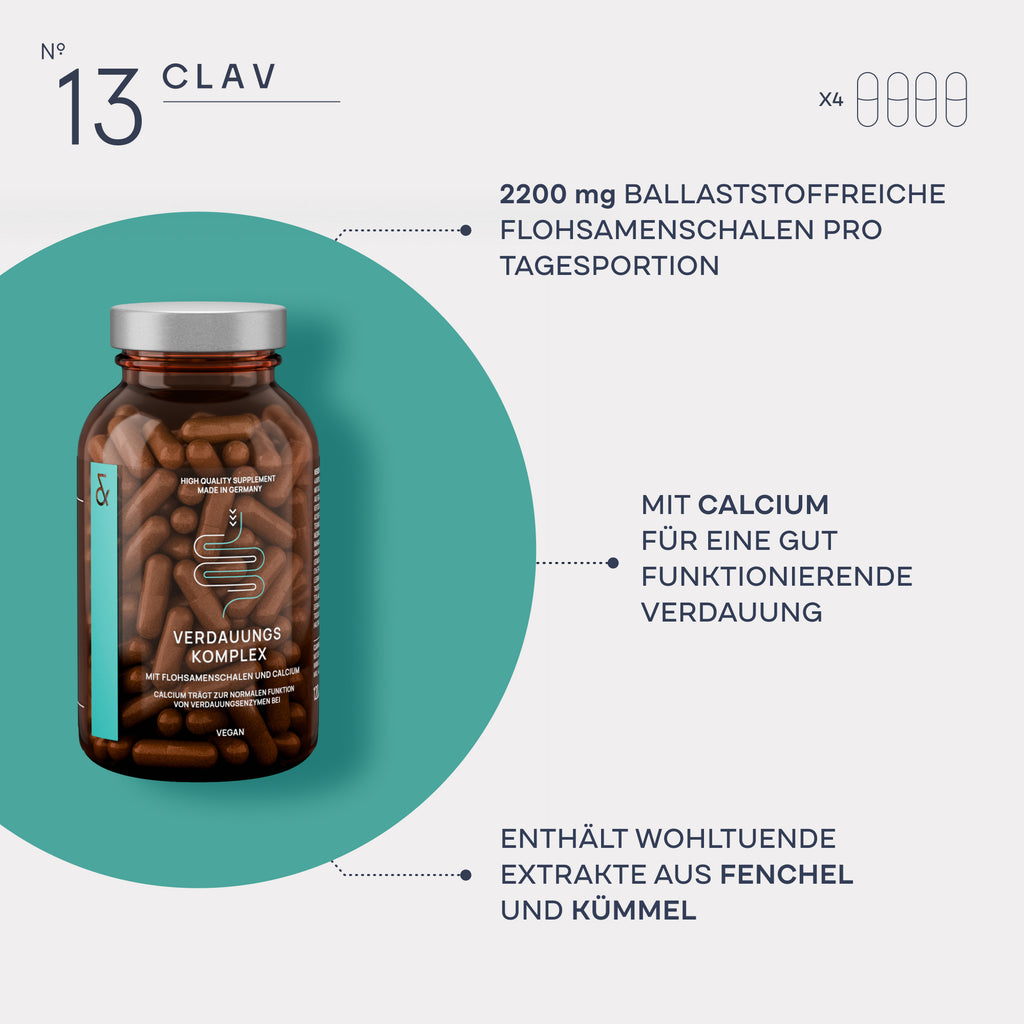
Our N°13 Digestion Complex contains supportive plant extracts such as caraway and fennel, as well as psyllium husks, which gently stimulate digestion. Psyllium husks consist of fibre that can swell significantly upon contact with liquid. They are known to provide a pleasant feeling of satiety and positively influence digestion. Psyllium husks are also used to alleviate irritable bowel syndrome.
An in vitro study from 2009 found that various essential oils, including caraway, are particularly suitable for combating an imbalance of harmful gut bacteria without harming beneficial bacteria. Therefore, caraway has been used for a very long time for gastrointestinal complaints. 4
Fennel has also been touted as a medicinal herb for several hundred years and is said to help with intestinal diseases and general digestive support. One study concluded that the barrier function of the gastrointestinal tract is indeed improved by fennel seeds. An impaired barrier function cannot adequately prevent harmful substances from entering the body, which can lead to inflammatory bowel diseases. This potential can be used to provide an alternative or complementary therapy for inflammatory bowel diseases. 5
Advertisement
-
·Multivitamins
Multivitamin supplements are an excellent option for getting several vitamins and minerals at once. They are already dosed to meet your daily needs for the most important nutrients.
To investigate the effect of a multivitamin preparation, a study was conducted in which older healthy adults took a multivitamin and mineral supplement for 12 weeks. The supplementation improved vitamin C and zinc levels in the blood. In addition, the subjects reported an improved state of health. 6
This result shows that combined micronutrients can indeed support the improvement of the immune system.
-
Antioxidants
Antioxidants protect the body from free radicals and prevent the development of oxidative stress. This, in turn, strengthens the body's immune defence and helps it successfully fight off harmful invaders such as viruses, bacteria, and co. Especially vitamin C, OPC, selenium, and zinc are among the best-known antioxidants. Together, they can neutralise free radicals to prevent cell damage, among other things. You can find more on this topic here.
A diet rich in antioxidants can support the immune system and should not be neglected, especially on holiday. Antioxidant foods include honey, berries, nuts, cocoa, green tea, turmeric, apples, and grapes.
Why savings sets are particularly suitable for travel
Savings sets of dietary supplements are particularly advantageous for travel. They not only allow for the inclusion of perfectly coordinated products that ideally support and complement each other, but also for convenient transport. The products are lightweight, handy, and fit into any toiletry bag. Dietary supplements are also allowed in hand luggage, which is why many travellers opt for this option. The price advantage of savings sets is particularly worthwhile: they are cheaper in a set than individually and are therefore not only good for supporting your health but also for your wallet.
Conclusion
To ensure a smooth trip, we highly recommend taking additional probiotic, digestive support, antioxidant, and immune-boosting supplements. These support your immune system and have also proven effective against motion sickness and gastrointestinal issues. However, you still can't do without the protective measures that should be observed before and during the trip. A healthy diet, sun protection, a well-prepared travel first-aid kit, and strengthening your gut are the most important aspects to ensure you have an unforgettable vacation.
Sources
- Süddeutsche Zeitung. (2018, August 28). Why we often get sick on vacation. Süddeutsche.de. https://www.sueddeutsche.de/gesundheit/urlaub-krank-1.4119209
- McFarland LV. Meta-analysis of probiotics for the prevention of traveler's diarrhea. Travel Med Infect Dis. 2007 Mar;5(2):97-105. doi: 10.1016/j.tmaid.2005.10.003. Epub 2005 Dec 5. PMID: 17298915.
- Wilkins T, Sequoia J. Probiotics for Gastrointestinal Conditions: A Summary of the Evidence. Am Fam Physician. 2017 Aug 1;96(3):170-178. PMID: 28762696.
- Hawrelak JA, Cattley T, Myers SP. Essential oils in the treatment of intestinal dysbiosis: A preliminary in vitro study. Altern Med Rev. 2009 Dec;14(4):380-4. PMID: 20030464.
- Das B, Rabalais J, Kozan P, Lu T, Durali N, Okamoto K, McGeough MD, Lee BJ, Barrett KE, Marchelletta R, Sivagnanam M. The effect of a fennel seed extract on the STAT signaling and intestinal barrier function. PLoS One. 2022 Jul 8;17(7):e0271045. doi: 10.1371/journal.pone.0271045. PMID: 35802574; PMCID: PMC9269469.
- Fantacone ML, Lowry MB, Uesugi SL, Michels AJ, Choi J, Leonard SW, Gombart SK, Gombart JS, Bobe G, Gombart AF. The Effect of a Multivitamin and Mineral Supplement on Immune Function in Healthy Older Adults: A Double-Blind, Randomized, Controlled Trial. Nutrients. 2020 Aug 14;12(8):2447. doi: 10.3390/nu12082447. PMID: 32823974; PMCID: PMC7468989.


 DE-ÖKO-006
