

For some a taboo subject, for others one of the most important topics of all: our digestion. It is the center of our nutrient supply and health. Digestion is the place where our water balance is regulated, important hormones and messenger substances are produced, and pathogens are warded off. Well-functioning digestion and a healthy gut flora influence our immune system, skin appearance, and even mood. Conversely, many people find that psychological stress affects their digestion. Anxiety before an exam, stress before an important appointment, or even joyful anticipation can throw the gut out of balance. So there are many good reasons to pay a little more attention to our largest organ.
Table of Contents
5 useful tips to stimulate your digestion
The gut flora is a delicate interplay of various microorganisms. If it becomes unbalanced, this manifests itself in digestive problems such as diarrhea, constipation, or bloating. But skin impurities, an increased susceptibility to infection, or slight irritability can also be an indication of an unbalanced gut. Due to this sensitivity, the support you give your microbiome should be as gentle as possible. That's why you'll find five simple and natural home remedies here that you can use to stimulate your digestion and thus support your gut and overall well-being.
Tip 1 - Fiber is the Alpha and Omega of Digestion
Although not considered essential nutrients, fiber is enormously important for a healthy diet and good digestion. This category includes various plant components that are not broken down by enzymes in the small intestine and therefore reach the large intestine unchanged. There, they serve as food for gut bacteria and thus ensure the maintenance of the balance of the gut flora. Although bacteria are mentioned here, these are not pathogens. Quite the opposite: the gut microbiome refers to the multitude of helpful microorganisms that live in our gut and even protect it against hostile pathogens. More than 2000 different types of bacteria are known, and their composition is as individual as our fingerprint. What they all have in common, however, is that they need food. Since they live in the large intestine, it is important that the food we eat is not already processed beforehand. This is where the nature of the fiber comes into play. It remains undigested until it reaches the large intestine, where it serves as food for the protective bacteria. The metabolism by the gut bacteria produces various substances that maintain the gut environment, thus keeping your gut flora in balance and stimulating your digestion.
What all fibers have in common is a strong swelling capacity, i.e., the ability to bind water. The increase in volume exerts pressure on the intestinal wall. This, in turn, stimulates peristalsis, i.e., the movement of the intestine, and ensures that food passes through the intestine more quickly. This means that toxins excreted by our body remain in the intestine for a shorter time. Various studies link a rather rapid passage of food through the intestine with a reduction in the risk of colon cancer.(5)
The recommended daily dose of fiber for adults by the German Nutrition Society is 30g per day. On average, however, adults in Germany consume only just under 20g. A good home remedy to increase your fiber intake and thus boost your digestion is psyllium husks. They are excellent as a topping for a salad or as an addition to a smoothie. You can also take them plain before meals. It is important to always drink plenty of water with them.
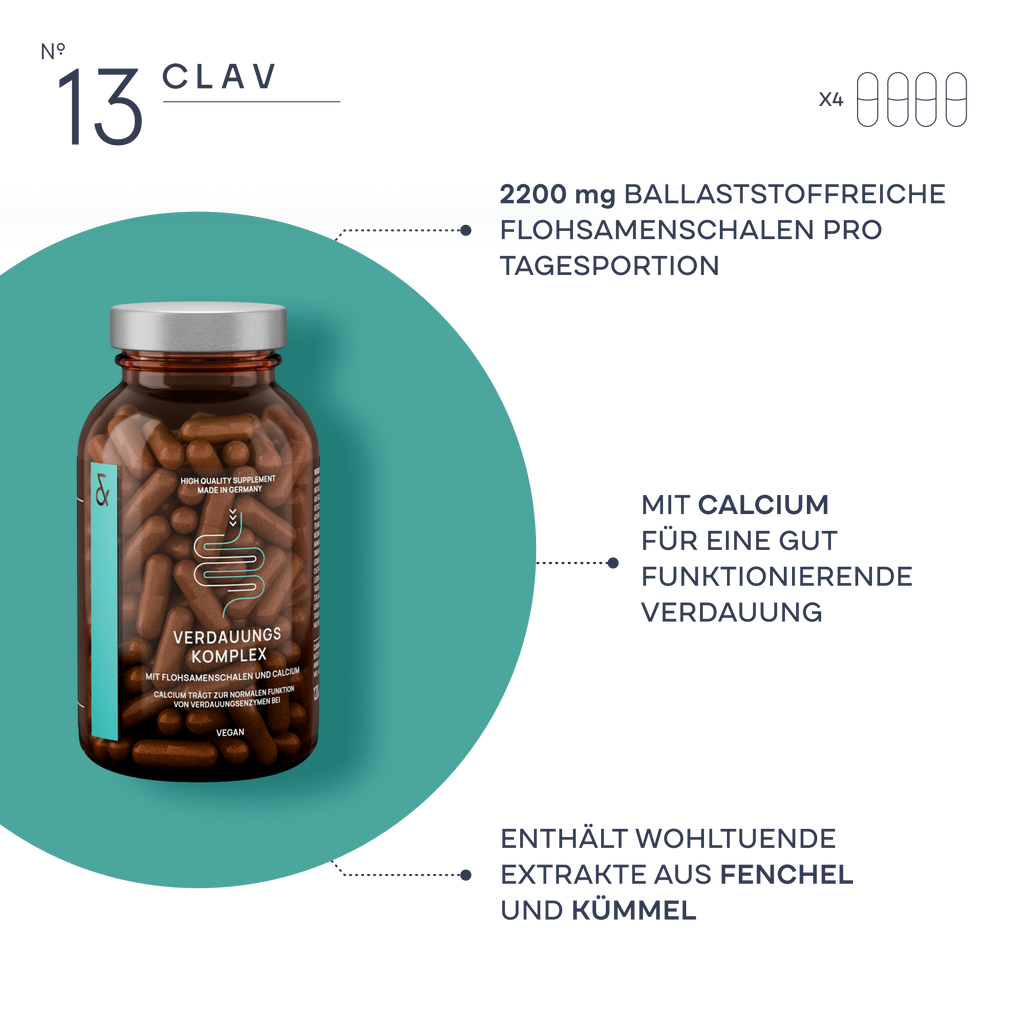
Discover the new Digestive Complex!
Advertisement
Tip 2 - Fermented foods more often
For thousands of years, people have fermented foods to preserve them. The first evidence of fermentation was found in China and dates back to the 7th millennium BC. Since then, however, the craft of fermenting has spread to all parts of the world. Whether vegetables, fish, dairy products or cereals, fermenting is a tradition in many cultures.
Even though foods were initially only fermented to preserve them, today we are aware of the numerous health benefits that fermented foods bring. For this reason, sourdough and co. are currently on a real triumph through the kitchens of the world. For example, there is evidence of a reduction in the risk of heart disease, diabetes, chronic inflammatory bowel diseases and muscle soreness after exercise³.
One thing is certain: fermented foods have a positive effect on the microbiome of our gut. They help to keep the bacterial strains in balance, which contributes to well-functioning digestion. This is because fermented foods contain probiotics, i.e. bacteria that help your gut fight pathogens. By eating probiotic foods, you ensure that the "good" bacteria remain in the majority and "bad" bacteria have no chance. In addition, fermented foods are more digestible than their natural counterparts. Cabbage, for example, loses its bloating effect during fermentation. Integrating natural yoghurt, kimchi, kombucha or sourdough bread into your diet more often is therefore an optimal and simple way to promote gut health.
Tip 3 - Ensure calcium supply
This mineral is usually associated with strong and healthy bones, but it can do even more. With calcium you can also stimulate your digestion, as it is an important factor for the function of our digestive enzymes. These break down our food into its individual components so that it can be utilized by the body. They thus ensure that all the nutrients we consume reach where they are needed. If the digestive enzymes do not function properly, food cannot be digested optimally. Then important vital substances are not absorbed, but simply excreted again. Of the many vitamins and minerals you consume, your body gets nothing if the enzymes don't play along. With a sufficient calcium intake, you can specifically support your digestion and digestive enzymes. Whole milk, yogurt and kefir, for example, have a high calcium content, but also green vegetables such as spinach and broccoli. Legumes such as chickpeas or white beans are also good calcium sources.

Tip 4 - Rely on herbal helpers
The centuries-old knowledge of natural medicine is still relevant in our modern society. For many minor ailments, they represent a good and gentle alternative to chemical products. Some plants are known to soothe the intestines, have an anti-bloating effect and thus increase well-being.
The go-to digestive aid in the home medicine cabinet is fennel-anise-caraway tea. Even if its taste is certainly debatable, the duration of its use speaks for itself. Traditionally, caraway is also used as a spice in dishes containing gas-inducing ingredients, for example in coleslaw. This is said to alleviate the bloating effect of cabbage even during the meal. In many Asian countries, you get mukhwas after eating. These are partly sugar-coated fennel seeds that you chew to combat bad breath and prevent digestive problems. The effect on the intestines is attributed to the essential oils they contain, which have anti-inflammatory and antispasmodic properties. They have been used for centuries as a home remedy to stimulate digestion. Fennel and caraway are a real power duo when it comes to herbal digestive aids.
Tip 5 - Stay active
Movement is the solution to so many problems. And its absence is the root of so many ailments we face as a society. When we move, circulation is stimulated, bone, joint, and muscle health is promoted, our mood improves, and cardiovascular diseases are prevented. The list is much longer. Movement also plays an important role in digestion. When blood circulation is stimulated, the intestines also work more actively. But it doesn't have to be a sprint or a 5-km run. Even small movements can stimulate your digestion. A relaxed walk after a meal or various exercises that you can integrate into your daily life can help. For example, you can take the stairs instead of the elevator, or walk for shorter distances instead of taking the bus or train.
Finally feel harmony in your stomach
The seat of our immune system, gut brain, gut feeling - the various terms associated with the gut show how important it is for our health. An unbalanced gut can affect numerous aspects of physical and mental health. Accordingly, a healthy gut is the best foundation for our health and general well-being. With these five tips and home remedies, you can stimulate your digestion naturally and easily and are on the best path to a harmonious gut and a good gut feeling.
Sources:
- Fu J, Zheng Y, Gao Y, Xu W. Dietary Fiber Intake and Gut Microbiota in Human Health. Microorganisms. 2022 Dec 18;10(12):2507. doi: 10.3390/microorganisms10122507. PMID: 36557760; PMCID: PMC9787832.https://www.ncbi.nlm.nih.gov/pmc/articles/PMC9787832/
- Hu J, Wang J, Li Y, Xue K, Kan J. Use of Dietary Fibers in Reducing the Risk of Several Cancer Types: An Umbrella Review. Nutrients. 2023 May 30;15(11):2545. doi: 10.3390/nu15112545. PMID: 37299507; PMCID: PMC10255454. https://www.ncbi.nlm.nih.gov/pmc/articles/PMC10255454/
- Leeuwendaal NK, Stanton C, O'Toole PW, Beresford TP. Fermented Foods, Health and the Gut Microbiome. Nutrients. 2022 Apr 6;14(7):1527. doi: 10.3390/nu14071527. PMID: 35406140; PMCID: PMC9003261. https://www.ncbi.nlm.nih.gov/pmc/articles/PMC9003261/
- Kirchhoff P, Geibel JP. Role of calcium and other trace elements in the gastrointestinal physiology. World J Gastroenterol. 2006 May 28;12(20):3229-36. doi: 10.3748/wjg.v12.i20.3229. PMID: 16718844; PMCID: PMC4087967. https://www.ncbi.nlm.nih.gov/pmc/articles/PMC4087967/
- Song BK, Cho KO, Jo Y, Oh JW, Kim YS. Colon transit time according to physical activity level in adults. J Neurogastroenterol Motil. 2012 Jan;18(1):64-9. doi: 10.5056/jnm.2012.18.1.64. Epub 2012 Jan 16. PMID: 22323989; PMCID: PMC3271256. https://www.ncbi.nlm.nih.gov/pmc/articles/PMC3271256/


 DE-ÖKO-006
